
THE PROBLEM
Dense breast tissue is common, consequential, and under-addressed
More than 38 million women in the United States have dense breast tissue, a common condition that can both increase breast cancer risk and make cancers harder to detect through mammography alone. As awareness grows through updated MQSA breast density notification requirements, more women and healthcare providers are seeking clearer guidance on when additional screening may be appropriate.
38M+
U.S. women have dense breast tissue
4x–6x
Higher breast cancer risk associated with dense breast tissue
60%
Of cancers may be missed in women with extremely dense breasts
THE SCIENCE
Why RNA, and why it matters for early detection
Many blood-based approaches rely heavily on cell-free DNA (cfDNA), which often requires tumor shedding and can be difficult to detect when disease burden is low. While these approaches have advanced cancer detection, they may face limitations in the earliest stages of disease.
Mammogen's platform focuses on cell-free RNA (cfRNA), a dynamic biomarker that can reflect active biology in real time. By capturing signals associated with both tumor activity and the body's response, cfRNA has the potential to provide meaningful insight earlier in the disease process.
Traditional cfDNA Approaches
Relies on tumor DNA entering the bloodstream
Often requires tumor shedding
Signal is tied to disease burden
Can be limited in very early-stage disease
Mammogen cfRNA Platform
Reflects active biological processes
Captures dynamic gene expression
Includes both tumor-associated and host-response signals
Designed to support earlier detection opportunities
EVIDENCE & READINESS
Built for translation. Backed by evidence.
Mammogen has generated a growing body of evidence across discovery, development, and validation, supporting the performance, robustness, and reproducibility of its RNA-powered diagnostic platform. Through peer-reviewed research, scientific presentations, and clinical validation efforts, the company continues to advance genTRU-breast™ toward broader clinical adoption.
99% Sensitivity
Achieved sensitivity in Stage I breast cancer of up to 99% using real-time qPCR assay technology.
Peer-Reviewed Science
Published research supporting assay performance, robustness, and reproducibility across multiple development stages.
SABCS Validation
Presented and validated before leading breast cancer experts at the San Antonio Breast Cancer Symposium (SABCS).
Clinical Development
Advancing prospective clinical validation designed to support commercialization and clinical integration.
*Based on internal validation data. Prospective clinical validation is ongoing.
WHAT'S NEXT
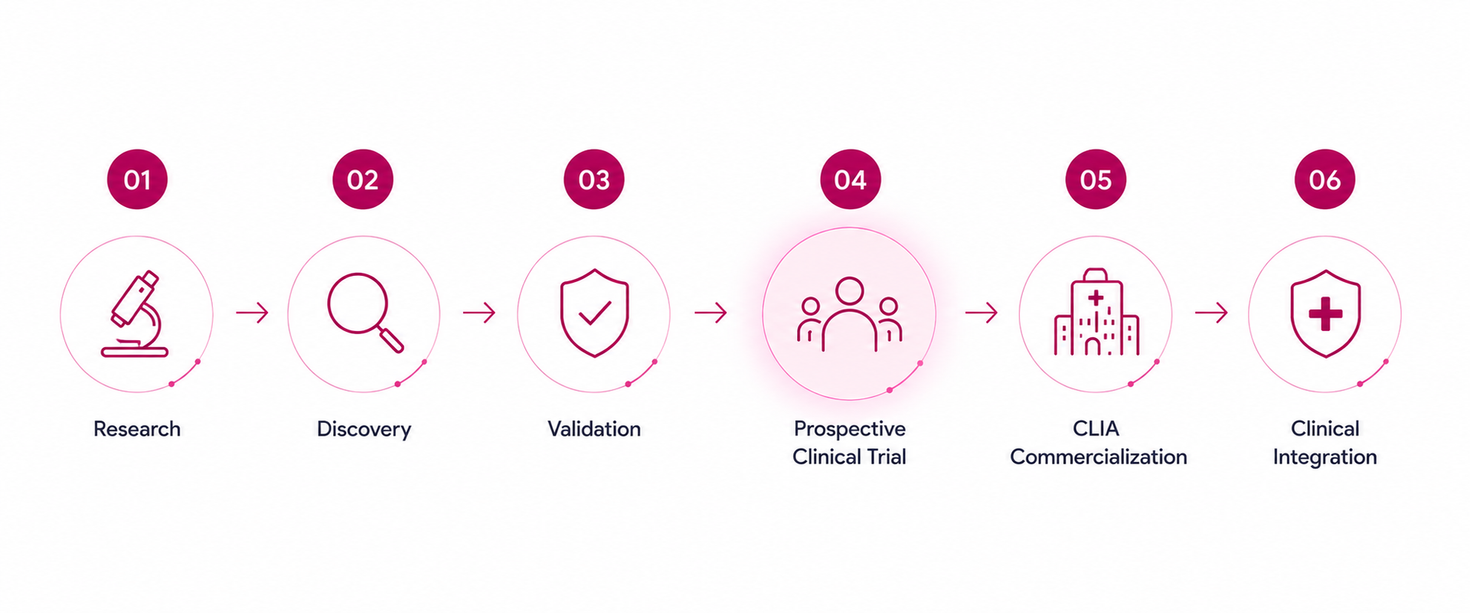
Our prospective clinical trial is underway
Mammogen is advancing a prospective clinical program designed to support broader clinical validation and a CLIA-enabled commercialization pathway. The objective is clear: move from validation to market entry with a scalable, clinically integrated product.
Pipeline/platform
One platform. A pipeline beyond breast cancer
Mammogen's disease-agnostic discovery engine is designed to identify novel cfRNA signatures that can be developed into future diagnostic applications. While genTRU-breast™ represents the company's lead program, the underlying platform is built to support a broader pipeline of molecular diagnostics across women's health, oncology, and other areas of unmet clinical need.
